KDT235-DC
XY Stages
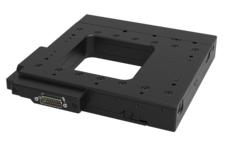
XY microscopy stage (ball screw), travel 50 x 50 mm, aperture 100 mm, rep ± 0.5 µm, load 8 kg, speed 60 mm/s

Scanning stage with large aperture
The space-saving design and large aperture characterize these robust XY stage. High precision ball screws and adjustable othogonality ensure highly precise positioning and running accuracies.
Designed for microscopy tasks
|
|
|
Options:
|
Fields of application
High-<link en/competence-center-positioning-technology/glossary/detail/?tx_dpnglossary_glossarydetail%5Bcontroller%5D=Term&tx_dpnglossary_glossarydetail%5Baction%5D=show&tx_dpnglossary_glossarydetail%5Bterm%5D=118&tx_dpnglossary_glossarydetail%5BpageUid%5D=252&cHash=63e7db6214b28acbc8b38f32b43ce162 title="smallest change in distance that a system can distinguish">resolution applications in microscopy, optical inspection systems, 3D imaging, screening, incident light measurements, transmitted light measurements, interferometry, metrology, autofocus systems, biotechnology, semiconductor testing
| Modell KDT235 | -50-DC-R | -50-DC-L | |
| Travel | [mm] | 50 | 50 |
| Repeatability unidirectional | [μm] | ± 2 | ± 0.5 |
| Repeatability bidirectional | [μm] | ± 2.5 | ± 0.7 |
| Accuracy | [μm] | ± 7.4 | ± 2.3 |
| Flatness | [μm] | ± 3.5 | ± 3.5 |
| Straightness | [μm] | ± 2.5 | ± 2.5 |
| Positioning speed | [mm/s] | 30 | 30 |
| Max. speed | [mm/s] | 60 | 60 |
| Max. acceleration | [m/s2] | 0.5 | 0.5 |
| Max. load Fx | [N] | 45 | 45 |
| Max. load Fy | [N] | 45 | 45 |
| Max. load Fz | [N] | 85 | 85 |
| Max. torque Mx | [Nm] | 5.2 | 5.2 |
| Max. torque My | [Nm] | 5.2 | 5.2 |
| Max. torque Mz | [Nm] | 7.2 | 7.2 |
| Pitch | [µrad] | ± 110 | ± 110 |
| Yaw | [µrad] | ± 70 | ± 70 |
| Weight | [kg] | 10 | 10 |
| Length | [mm] | 235 | 235 |
| Width | [mm] | 235 | 235 |
| Height | [mm] | 80 | 80 |
| Aperture | [mm] | 100 | 100 |
| Motor | DC-Motor | DC-Motor | |
| Feedback | Motor-Encoder | Linear Scale |
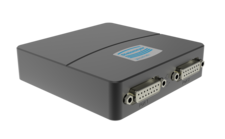
FMC220
Versatile combinable controller, ideal for laboratory applications, control of 1 - 128 axes simultaneously

FMC400/450
Multi-axis controller fully ready for tracking, simple creation of own programs.
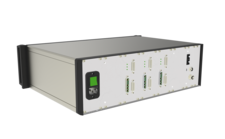
FMC250/280
Multi-axis controller with increased current and voltage for point-to-point positioning.
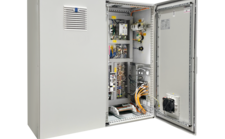
PLC
We support integration of our systems into PLC architectures, e.g. Beckhoff
ACS
We support integration of our systems into your ACS environment
Related Products
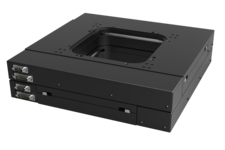
XY stage (ball screw), travel 100 x 100 mm, aperture 150 mm, rep ± 0.5 µm, load 7 kg, speed 60 mm/s
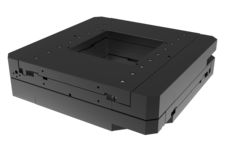
XY stage (ball screw), travel 155 x 155 mm, aperture 170 mm, rep ± 0.5 µm, load 11 kg, speed 50 mm/s
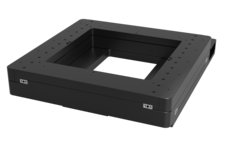
Nearly all atmospheric standard rotary stages shown here are optionally available in a non-anodized version with UHV-compatible lubrication for residual pressures up to 10E-6 mbar. In this configuration, they achieve at least cleanroom class ISO 6 - or better - making them suitable for demanding environments.
For higher requirements, specially designed rotary stage variants are available, for example for cleanroom class ISO 2, vacuum up to 10E-11 mbar, or harsh radiation environments.
The vacuum rotary stages are specifically engineered for high axial and radial loads. Reinforced bearing concepts, adapted material selection, and vacuum-compatible lubrication and coating systems ensure stable rotation even under high payloads and large moments of inertia.
Overview Cleanroom & Vacuum Rotary Stages Contact Technical Consulting
Materials for Rotary Stages
Steinmeyer Mechatronik primarily uses aluminum for the structural components of rotary stages. This material provides an optimal balance of weight, stiffness, and thermal conductivity—critical for precise runout and repeatability.
Aluminum efficiently dissipates localized heat, for example from motor losses or bearing friction. As a result, the rotary stage quickly reaches a thermally stable condition—an essential prerequisite for consistent angular accuracy during continuous operation or high-dynamic motion.
The lower stiffness of aluminum compared to steel is compensated by design measures, such as:
- Reinforced housing and bearing structures
- Optimized wall thicknesses and installation heights
- Hollow profile constructions with high torsional stiffness
For special requirements—such as high load capacities, vacuum-compatible designs, or magnetically sensitive applications—steel or titanium versions are available as alternatives.
Functional Surfaces and Coatings for Rotary Stages
In addition to standard finishes, numerous customized surface and coating concepts are available. These are specifically designed to achieve very high cleanroom classes—up to ISO 1–2, depending on the application and process.
To meet demanding process requirements, we develop and qualify application-specific functional coatings, including:
- Nickel coatings
- PTFE & KEPLA® coatings
- Fluorinated lubricants
- Dicronite® / dry-film coatings
- Application-specific coating combinations
The following surface options are also available:
- Anodized (cleaned)
- Alternative anodized colors
- Aluminum bare, cleaned
- Bilatal
- Nickel
These surfaces are particularly suitable for:
- High cleanliness requirements in cleanroom environments
- Vacuum applications
- Chemically aggressive environments (e.g., life sciences)
- Optical systems with stray light requirements
Why Functional Coatings Are Critical for Rotary Stages (Before → After)
- Standard surface → EUV-compatible surface
- Reflective → Non-reflective, minimized stray light
- Standard sliding behavior → Optimized friction coefficients & reduced wear
- Basic protection → Enhanced chemical & corrosion resistance
- Standard configuration → Application-optimized performance
Special surface treatments are often required for UV / DUV / EUV applications (X-ray or gamma applications available upon request).
Yes. Our rotary stages can be modularly combined with linear, XY, or XYZ stages to form compact multi-axis systems (e.g., XYZ-R or Theta-Z). The required mechanical interfaces are already integrated into the design.
Typical Configurations
- XY + R → Compact rotation and positioning systems
- XYZ + R → 4DOF positioning
- Theta-Z → Combined rotational and vertical motion
- Parallel kinematic structures → For active alignment applications
Advantages of the Combination
- High system flexibility
- Modular expandability
- Space-saving integration
- Precise coordination of rotation and translation
Technical Requirements
- Matched mechanical interfaces (mounting pattern / centering)
- Rotary stage load capacity designed for additional axes (Fx, Fy, Fz)
- Consideration of moment of inertia and center of gravity
- Synchronized control of all axes
We are happy to advise you—quickly and without obligation:
For rotary stages, Steinmeyer offers standard motion controllers, PLC integration, as well as custom embedded solutions. Depending on torque requirements, dynamic performance, and installation constraints, the controller can be implemented externally in a control cabinet or fully integrated into the rotary stage module.
Overview Motion Controllers & Control Concepts
System Architecture – Optimized for Rotary Axes
Control solutions for rotary stages are selected application-specifically and precisely matched to the drive concept (e.g., torque direct drive or geared drive), angular measurement system, and environmental conditions. Particular focus is placed on runout accuracy, axis synchronization, and thermal stability.
Standard Motion Controllers
- For single rotary stages or rotational multi-axis systems (e.g., XYZ-R)
- Configurable control loops (position / speed / torque)
- High-resolution angular feedback
- Fieldbus interfaces (e.g., EtherCAT, PROFINET)
- Fast commissioning and fine-tuning
Typical application: Precision rotary stages with torque motor, direct drive, or gear-based rotation.
PLC Integration
- Integration into existing machine or system control architectures
- Centralized system logic via customer PLC
- Synchronization with linear axes or gantry systems
- Standardized industrial communication protocols
Typical application: OEM equipment, inspection systems, semiconductor tools, or assembly systems.
Custom Embedded Solutions
- Compact, application-optimized controllers for rotary stage modules
- Integrated power stages for torque or servo motors
- Reduced cabling effort
- Optimized for cleanroom, vacuum, or high-dynamic applications
Typical application: Highly integrated rotational systems with limited installation space or increased requirements for dynamics and precision.
Are you looking for a technical solution for your application?
Get your first 3D Design in a few days:

Katja Weißbach
Consulting
T +49 351 88585-64
E-Mail

Ronald Schulze
Consulting, Project Management & Engineering
T +49 351 88585-67
E-Mail

Francisco Samuel
Consulting &
Project Management
T +49 351 88585-85
E-Mail

Elger Matthes
Consulting, Concepts, Innovation & Engineering
T +49 351 88585-82
E-Mail
Our references