KDT380-DC
XY Stages
XY stage (ball screw), travel 155 x 155 mm, aperture 170 mm, rep ± 0.5 µm, load 11 kg, speed 50 mm/s

Precision aperture stage for heavy loads
The KDT380 heavy-duty XY stage with aperture enables high-precision positioning of heavy loads up to 20 kg. The use of a free ball screw drive enables maximum precision as well as excellent running behavior, while at the same time providing very high rigidity and a long life time.
Highly compact for a wide range of inspection tasks
|
|
|
Options:
|
Fields of application
metrology, high resolution microscopy, 3D inspection, inspection systems, inspection technology, automatic optical inspection (AOI), inline inspection, surface inspection, coating thickness measurement
| Modell KDT380 | -155-DC-R | -155-DC-L | -155-SM | |
| Travel | [mm] | 155 | 155 | 155 |
| Repeatability unidirectional | [µm] | ± 2 | ± 0.5 | ± 1.6 |
| Repeatability bidirectional | [µm] | ± 2.5 | ± 0.7 | ± 2.1 |
| Accuracy | [µm] | ± 13.5 | ± 3.5 | ± 13.2 |
| Flatness | [µm] | ± 11 | ± 11 | ± 11 |
| Straightness | [µm] | ± 3.9 | ± 3.9 | ± 3.9 |
| Positioning speed | [mm/s] | 35 | 35 | 13 |
| Max. speed | [mm/s] | 50 | 50 | 20 |
| Max. acceleration | [m/s2] | 0.5 | 0.5 | 0.2 |
| Max. load Fx | [N] | 45 | 45 | 45 |
| Max. load Fy | [N] | 45 | 45 | 45 |
| Max. load Fz | [N] | 110 | 110 | 110 |
| Max. torque Mx | [Nm] | 5.3 | 5.3 | 5.3 |
| Max. torque My | [Nm] | 5.3 | 5.3 | 5.3 |
| Max. torque Mz | [Nm] | 5.1 | 5.1 | 5.1 |
| Pitch | [µrad] | ± 190 | ± 190 | ± 190 |
| Yaw | [µrad] | ± 120 | ± 120 | ± 120 |
| Wight | [kg] | 30 | 30 | 30 |
| Length | [mm] | 380 | 380 | 380 |
| Width | [mm] | 380 | 380 | 380 |
| Heigt | [mm] | 100 | 100 | 100 |
| Aperture | [mm] | 170 x 170 | 170 x 170 | 170 x 170 |
| Motor | DC-Motor | DC-Motor | Stepper Motor | |
| Feedback | Motor-Encoder | Linear Scale | Open Loop |

FMC400/450
Multi-axis controller fully ready for tracking, simple creation of own programs.
ACS
We support integration of our systems into your ACS environment
PLC
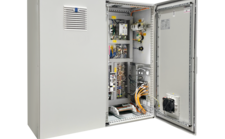
We support integration of our systems into PLC architectures, e.g. Beckhoff
FMC250/280
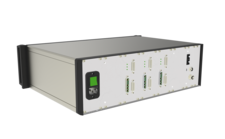
Multi-axis controller with increased current and voltage for point-to-point positioning.
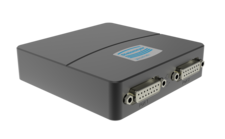
FMC220
Versatile combinable controller, ideal for laboratory applications, control of 1 - 128 axes simultaneously
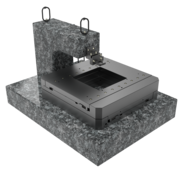
Related Products
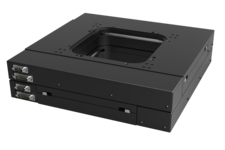
XY stage (ball screw), travel 100 x 100 mm, aperture 150 mm, rep ± 0.5 µm, load 7 kg, speed 60 mm/s
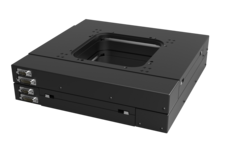
XY microscopy stage (ball screw), travel 50 x 50 mm, aperture 100 mm, rep ± 0.5 µm, load 8 kg, speed 60 mm/s
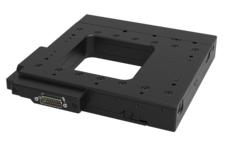
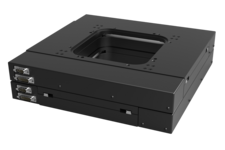
XY stage (ball screw), travel 100 x 100 mm, aperture 150 mm, rep ± 1.6 µm, load 7 kg, speed 20 mm/s
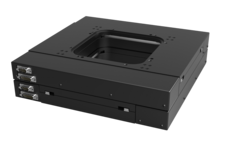
XY microscopy stage (ball screw), travel 50 x 50 mm, aperture 100, rep ± 1.6 µm, load 8 kg, speed 20 mm/s
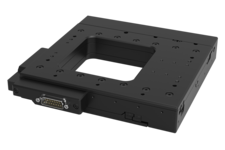
Almost all atmospheric standard stages are unanodized with UHV lubrication for residual pressures up to 10-6 mbar and min. cleanroom class ISO 6 - or even better - available. Further stages for more demanding environments up to cleanroom class ISO 2, vacuum up to 10E-11 mbar or hard radiation you will find here:
Overview Clean Room & Vacuum Stages Get in touch with our technical consultant
Materials
Steinmeyer Mechatronik GmbH predominantly uses aluminum for the structure of multi-axis positioning systems.
In special cases, steel and titanium (e.g., for non-magnetic systems) are also possible.
The reason: aluminum efficiently dissipates localized heat, allowing the system to quickly reach a thermally stabilized state—an essential prerequisite for stable and highly accurate positioning systems.
The lower stiffness of aluminum compared to steel is compensated for by design measures, such as:
- a slightly increased table height
- the use of hollow profiles
Important: An aluminum beam and a steel beam with identical geometry exhibit the same deflection under their own weight. For special requirements—e.g., non-magnetic applications—titanium versions are also available.
Functional surfaces and coatings
In addition to standard surfaces, numerous customer-specific surface and coating concepts are available.
These are specifically designed to achieve very high cleanroom classes—up to ISO 1–2, depending on the application and process.
To meet demanding process requirements, we develop and qualify application-specific functional coatings, including:
- Nickel coatings
- PTFE & KEPLA® coatings
- Fluorinated lubricants
- Dicronite® / dry-film coatings
- Application-specific coating combinations
In addition, the following options are available:
- anodized (cleaned)
- alternative color anodizing
- bare aluminum, cleaned
- Bilatal
- Nickel
These surfaces are suitable, for example, for high purity requirements, chemical resistance (life science), or process-critical environments.
Why functional coatings are crucial (before → after)
- Standard surface → EUV-compatible surface
- Reflective → non-reflective, minimized stray light
- Limited sliding capability → maximum sliding performance & reduced wear
- Basic protection → chemical & corrosive resistance
- One-size-fits-all → cost-optimized, application-specific performance
Special surfaces are often required for UV / DUV / EUV applications (X-ray or gamma applications on request).
Yes, linear stages can also be used as lifting stages (Z direction) and stacked (XY motions).
In this case, it is important that the maximum force in the drive direction is not exceeded. The force for vertical positioning is specified for linear stages under Fx in the specifications.
The selection is primarily based on force requirements, dynamics, and required precision. Additional relevant factors include installation space, energy efficiency, thermal boundary conditions, and integration effort. Depending on the application, different drive systems can be used. These are identifiable by abbreviations in the respective product designation:
- Ground ball screws or lead screws with SM motor (stepper motor), DC motor (brushed DC motor), or AC servo (AC servo motor)
- Electrodynamic linear motors (ironless or iron-core)
- Piezo motors such as Piezo-Legs® or Nanomotion®
Systematic Decision Structure
| If priority is on … | Typical motor type |
|---|---|
| Cost & simple integration | Stepper motor |
| Dynamics & control performance | DC servo / BLDC |
| Maximum dynamics & zero backlash | Linear motor |
| Nanopositioning & compact design | Piezo / Nanomotion / Ultrasonic |
1. Stepper Motor
Typical Application
Simple positioning tasks with moderate speeds and forces.
Advantages
- Cost-effective
- Simple control (often without complex feedback control)
- High holding torque at standstill
Disadvantages
- Step loss under overload (without feedback)
- Reduced smoothness at low speeds
Recommended for
- Standard axes
- Laboratory automation
- Simple adjustment tasks
- Alignment units with low dynamic requirements
- Vacuum applications
2. DC Servo or BLDC Motor
Typical Application
Dynamic positioning with closed-loop control and encoder feedback.
Advantages
- Very smooth operation
- High speed and acceleration
- Precise control through feedback
Disadvantages
- Higher system cost
- Requires servo drive and parameterization
Recommended for
- High-speed XY tables
- Scanning axes
- Automation systems with position and velocity control
- Multi-axis systems with synchronization
3. Linear Motor
Typical Application
Direct drive without mechanical transmission for maximum dynamics.
Advantages
- No backlash, no mechanical wear
- Extremely smooth motion
- Very high accelerations
Disadvantages
- Higher investment cost
- Increased energy consumption
- Thermal management required
Recommended for
- High-dynamic systems in semiconductor manufacturing
- Inspection and metrology systems
- Precision assembly
- Applications with high cycle rates
4. Piezo, Nanomotion or Ultrasonic Motor
Typical Application
Nanometer-level motion or highly compact precision systems.
Advantages
- No magnetic fields
- Extremely fine step resolution
- High holding force without power consumption
Disadvantages
- Limited travel range
- Low to moderate speed
- Not designed for high continuous loads
Recommended for
- Nanopositioning systems
- Optical alignment and fine adjustment
- Microscopy and laser alignment
- Vacuum or magnetically sensitive applications
- Compact systems with minimal installation space
Incremental scales made of steel or Zerodur® or Zeromet® are used as a feedback system in most cases. While this is sufficient for accuracy in the single-digit micrometer range, it makes sense to use interferometric position feedback for accuracy requirements below one micrometer. In systems with “open loop”, i.e. without a measuring system, only precision in the double-digit micrometer range can be achieved; however, due to the simpler controller and the lack of a measuring system, this is the more cost-effective solution.
Steinmeyer offers standard motion controllers, PLC integration, and custom embedded solutions. Depending on the application, the control system can be fully integrated into the positioning system.
Overview Motion Controllers & Control Concepts
System Architecture – Modular Design
Control solutions are selected application-specifically and matched to the drive system, measurement system, and environmental conditions.
Standard Motion Controllers
- For single-axis or multi-axis systems
- Configurable control loops (position / velocity / torque)
- Fieldbus interfaces (e.g., EtherCAT, PROFINET)
- Fast commissioning
Typical application: Precision axes with linear motors, torque motors, or ball screws.
PLC Integration
- Integration into existing machine control systems
- Centralized system logic via customer PLC
- Reduced integration effort
- Standardized industrial communication
Typical application: OEM machines, scalable production systems, and retrofit projects.
Custom Embedded Solutions
- Compact, application-optimized controllers
- Integrated power stages
- Minimized installation space
- Optimized for process-specific applications
Typical application: Highly integrated positioning systems with limited installation space or special environmental requirements.
Are you looking for a technical solution for your application?
Get your first 3D Design in a few days:
Katja Weißbach
Consulting
T +49 351 88585-64
E-Mail
Ronald Schulze
Consulting, Project Management & Engineering
T +49 351 88585-67
E-Mail

Francisco Samuel
Consulting &
Project Management
T +49 351 88585-85
E-Mail

Elger Matthes
Consulting, Concepts, Innovation & Engineering
T +49 351 88585-82
E-Mail
Our references